
Muse Vineyards is located at the heart of the Shenandoah Valley. At Muse, science, passion and reverence for the tradition of classic wine making converge to produce award-winning wines.
In 2015, Muse’s 2009 Clio, a Bordeaux-style blend was named Virginia’s top wine and awarded the coveted 2015 Virginia Governor’s Cup, besting 400 entries from across the state. In the ensuring years it has won dozens of awards from the most demanding blind-tasted wine competitions. We practice time-honored farming and wine production techniques in homage to the domaine vineyards of France and Italy. Rarely larger than 35 acres and often-family owned and operated for centuries, these vineyards represent for us the ideal of premium, natural wine making.
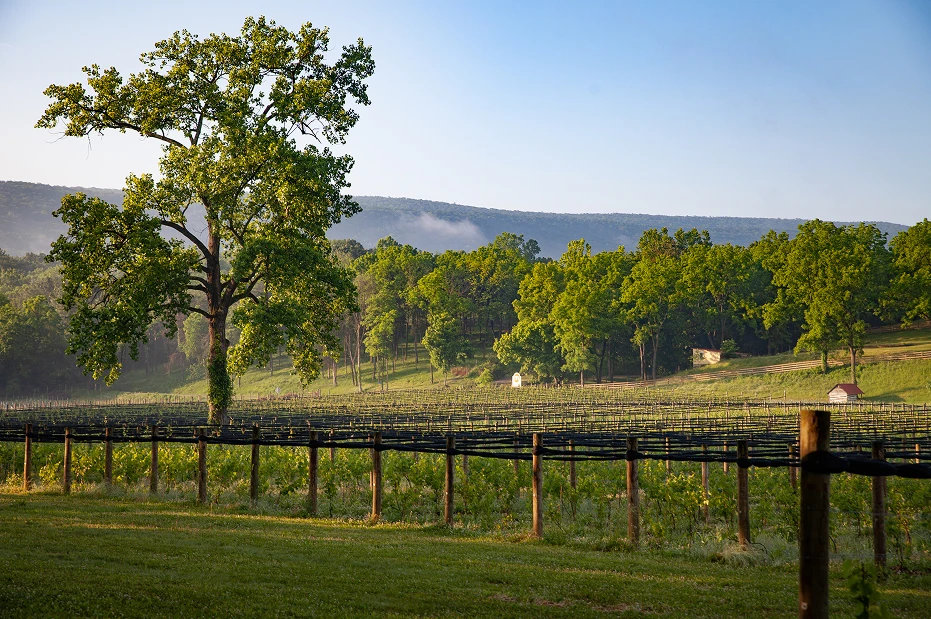
Our viticultural philosophy and practice is based on minimalist agriculture. Our commitment is to employ only the latest generation of low-impact materials and taking great care in when and how we use them. Every function from pruning to harvest is done by hand.
Muse Vineyards comprises thirty contiguous acres of vines, and within that modest footprint lie three distinct soils: shale, sandy river alluvium, and a thin loam over stony red clay. Each is a remnant of the changing pathways of the North Fork of the Shenandoah River, which over millions of years has cut its way down through the Valley’s shale and sandstone. As the river deepened its channel, it left behind staircase-like level shelves along the hillside.
The highest of these steps is the Upper Vineyard, set near 1,000 feet on a terrace the river formed when it ran a full hundred feet above its current course. Here a loose loam weathered from crystalline rock covers red gravelly clay, which begins about three feet down. The clay owes its color to iron oxidized over long exposure to air and water, a sign of how many ages this ground has stood undisturbed by the river below. Gentle inclines combine with the rocky soil to shed water readily, obliging the vines to root deeply in search of it.
Beside the tasting room, the ground falls away abruptly over an outcrop of fractured shale. This rock began as fine mud settling on the floor of ancient seas that once covered the region, compacted over time into thin, brittle layers and later tilted and exposed as the Appalachians rose and the river carved through them. Little topsoil has had the chance to accumulate on so steep a face, and the thin, mineral soil that does cling to it restrains the vines’ vigor and concentrates their fruit.
At the foot of the property, the Lower Vineyard follows the riverbank on silt loam alluvium, the fine residue of sandstone and shale eroded upstream and deposited by the Shenandoah during its periodic floods. This is the youngest ground on the estate and the deepest; its finer texture holds more moisture than the slopes above, and it continues to be renewed whenever the river overtops its banks.
The mountains and the river create for Muse a microclimate within the greater Shenandoah Valley. The river moderates temperatures across the estate, and the mountains a quarter mile away act as a rain shield.
Because the vineyards are dry-farmed, the vines depend entirely on what the soil can retain; a cover of grasses between the rows helps the ground absorb rainfall, and the slight drought stress of late summer hastens ripening. The land has been farmed continuously since 1792, and after years of conventional cultivation under earlier owners, the soil has recovered enough of its natural balance that earthworms have returned to the vineyards.


Like many Americans, farming is a large part of Robert’s background. In the 17th Century, his French Huguenot ancestors came to America and settled on the banks of the Potomac where they started planting tobacco. Their property adjoined George Washington’s birthplace.
In 2003 Robert and Sally drove to Woodstock, Virginia to look at a property with an overgrown vineyard. They bought the property specifically for the vineyard and began working to resuscitate the vines.
Robert & Sally next purchased a 200-year-old Mennonite farm adjacent to their property on the banks of the Shenandoah River and expanded to thirty acres of vines. After much research they learned how to combine the qualities of Muse’s soil, its topography, and its proximity to the river to produce a range of exceptional wine grapes.







Reserve a tasting or plan your weekend with us.